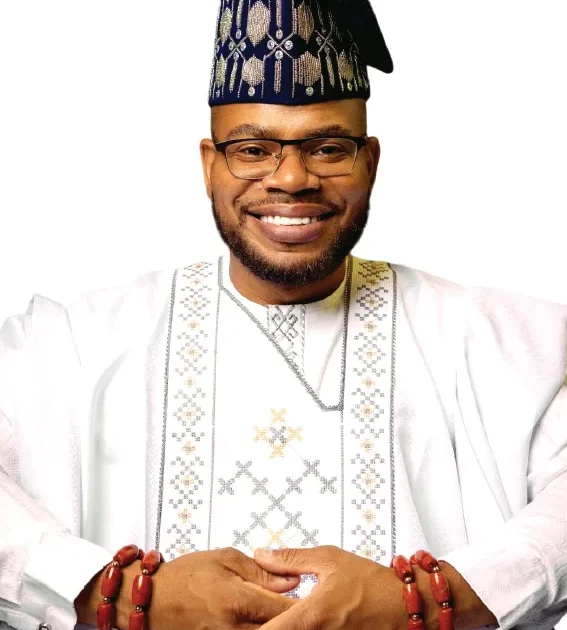
My ancestry search ended in Lagos royal family — US-born Nigerian, Olomo
Can you take us through your professional journey?
I was born and raised in the United States, and much of my professional life began in entrepreneurship, marketing, and business development.
Over the years, I learned how to build companies, develop brands, and turn ideas into systems that could grow beyond the person who started them.
For a long time, that was how I understood success. Eventually, though, another question became equally important to me: what existed in my family history before America? Like many African Americans, I could trace generations of my family in the United States, but there came a point where the historical record stopped telling us who our African ancestors actually were. Their American history was documented, yet their earlier identities, their people, communities, languages, and family relationships, had largely disappeared from the written record.
That question drew me into ancestry and genealogical research. What began as a personal search gradually became much more specific, eventually connecting my family history to the Yoruba people of Nigeria and later to a named lineage within Imota.
Once that happened, I began thinking about the millions of people throughout the African diaspora carrying similar unanswered questions. There were ancestry companies capable of telling people that they were Nigerian, Yoruba, Igbo, or connected to another African population, but very few organisations helped people understand what to do after that discovery. That realisation became the foundation of Tribal Tapestry.
What experiences shaped your career and worldview?
Entrepreneurship taught me that when an institution does not exist to solve a problem, sometimes you have to build it yourself. That lesson became especially important during my ancestry journey. African Americans know a great deal about what happened to our ancestors after they arrived in America. We know the history of slavery, segregation, civil rights, and the long struggle for freedom and equality.
Those chapters matter enormously, but eventually I became fascinated with the chapter that came before them. Before someone appeared in an American record as enslaved, that person already had an identity. They belonged to a family. They came from a community. They spoke a language and inherited traditions that existed long before America entered their story.
Understanding that changed how I thought about legacy. Professional accomplishment still matters to me, but success became less about what I could accumulate personally and more about what could be recovered, built, and passed forward.
You were born in the United States. What understanding did you have of Africa growing up?
Africa was always present in the larger African American identity, but usually in the broadest possible sense. We knew our ancestors came from Africa. The difficulty is that Africa is an enormous continent, and knowing that someone is African does not tell you their people, family, language, community, or history.
As I grew older, that broad answer became less satisfying. Nobody would tell an American of European ancestry that being “European should answer every question about where their family came from. They want to know whether their ancestors were Irish, Italian, German, Polish, or something else. They often know the towns, family names, and stories behind those identities. I began asking why descendants of enslaved Africans should accept less specificity simply because history made our search more difficult. That became one of the questions that drove me.
What were some of the biggest questions you had about your identity before tracing your ancestry?
The question underneath everything was simple: who were we before America? For many African American families, the historical record eventually becomes less descriptive precisely because slavery stripped identifying information away from people.
You may be able to follow a family through Virginia, Georgia, or another American state for generations and then reach a point where an African ancestor’s original name, community, or lineage is no longer recorded. That absence fascinated me. Could DNA help recover part of the story? Could genealogy take us further? Could family relationships, historical records and knowledge preserved within African communities fill in information that American archives could not?
Most importantly, begin identifying actual people, places and family histories.
What motivated your desire to trace your African roots?
Curiosity may have started it, but restoration became the deeper motivation. The transatlantic slave trade disrupted more than geography. It disrupted family memory. Names, languages and communities disappeared from family histories. Generations inherited the consequences of that separation without necessarily inheriting the knowledge of the identities that came before it.
Previous generations did not have many of the tools available to us today. DNA testing can reveal population connections and biological relationships. Genealogical databases allow records to be compared across enormous collections. Oral histories and family knowledge preserved in African communities can sometimes provide context that never appeared in an American archive.
For the first time, descendants throughout the diaspora have an opportunity to push against that historical wall. Once I understood what might be possible, I wanted to know how far the evidence could take us.
Did you discover anything about your ancestry?
My research established very strong Yoruba ancestry, but the story became much more significant as the genealogical work continued. Rather than stopping with an ethnic identification, I kept following the family history. That research eventually led to the Senlu Royal House of Imota in Lagos State. What made that discovery especially meaningful was that it did not remain something I was claiming based solely on my own research. The family history was taken to Imota, where the lineage could be considered within the community itself.
Ultimately, the Ranodu of Imota, His Royal Majesty Oba Dr. Mudashiru Ajibade Bakare-Agoro, issued me a formal letter of attestation recognising my descent from the Senlu Royal House.
That was a profound moment for me. There is an enormous difference between receiving a commercial DNA result identifying Yoruba ancestry and being able to follow a family line to a named royal house, a specific community and formal recognition from the traditional authority entrusted with that history. It also reinforced something I believe strongly: ancestry should be approached with evidence and responsibility. DNA can tell us a great deal, but lineage involves genealogy, family history, community memory and recognition.
Does discovering your Yoruba ancestry and connecting with Nigeria change your understanding of identity and belonging?
The experience made identity far less abstract. Reading that your ancestry points toward a place is one thing. Developing actual family, community, and cultural relationships there is something entirely different. Nigeria gradually moved from being somewhere I was researching into somewhere where I had relationships and responsibilities.
As the genealogy became more specific, certain relationships also took on a different character. They were no longer simply relationships I had chosen to develop after arriving in Nigeria; some were connected to family history that had been rediscovered and recognised. That changed how I thought about belonging.
Belonging cannot be reduced to DNA, but documented lineage should not be treated as merely symbolic either. Family history, recognition, relationships and responsibility all matter. Eventually, the question stopped being only, “Where do I come from?” A more important question followed: “Now that I know, what am I responsible for?”
What history is behind your title “Pathfinder”?
The title grew out of the work I had already begun doing with the diaspora. Through Tribal Tapestry, I was helping descendants of Africa trace their ancestry, come to Nigeria, experience the culture, and build relationships with the communities connected to their heritage. That work was eventually recognised traditionally in Ikorodu, where I received the title, ‘Base ̀ tò
Ìpadàbo ̀ Sílè’, which I explain in English as ‘Pathfinder who leads the Diaspora back to their source’.
I regard that title primarily as a responsibility. It describes the work. My role is to help create pathways so that people whose ancestors were separated from Africa generations ago have a greater chance of discovering where their story began and establishing a meaningful relationship with that place. The title did not create the mission. The mission came first. The recognition simply gave language to the work I was already doing.
What are some of the major setbacks you encountered?
Entrepreneurship teaches you very quickly that progress is rarely linear. Some ideas work immediately. Others take years to mature. Institutional relationships move at different speeds, ancestry research can produce unexpected turns, and working across countries and cultures requires patience.
One lesson that has stayed with me is the importance of separating the vision from the method. A method can fail without the vision being wrong. If one research path reaches a dead end, another may remain open. If an institution is not ready for a particular conversation, you continue building the relationship instead of trying to force an outcome.
Persistence matters, but patience matters just as much. Some of the most meaningful relationships in my life developed because I allowed them to mature naturally.
What problem have you identified in the ancestry and genealogy space?
The industry became very good at giving people information, but information is not the same thing as relationship. A percentage can be useful. A regional result can be valuable. A family tree can reveal extraordinary things. But our ancestors were not percentages. They belonged to families and communities.
Tribal Tapestry was created because I wanted to see how far responsible research could take that reconnection. Sometimes the evidence may lead only to an ethnic group. In other cases, genealogy can move toward a more specific community. Occasionally, DNA and family research may even lead toward living relatives.
The important thing is maintaining the standard of evidence. There is a difference between wanting to belong somewhere and doing the work necessary to establish what the historical and genetic record can actually support.
What do you mean when you speak about the “Homecoming Economy”?
The Homecoming Economy describes what happens when diaspora reconnection moves beyond occasional tourism and begins creating sustained relationships with Africa. Travel is part of it, but the economic activity goes much further.
People stay in hotels, hire drivers and guides, purchase clothing and art, invest in businesses, and sometimes purchase property. Families return repeatedly. Some eventually divide their time between continents. All of that creates economic activity. My argument is that African nations should recognise this deliberately rather than allowing it to develop accidentally.
The diaspora should not only be welcomed with emotional language about returning home. Practical systems should exist that allow people with genuine ancestral connections to build meaningful relationships here. When the cultural relationship becomes durable, the economic relationship often follows.
How many people have you helped to reconnect with their African ancestry?
Through Tribal Tapestry, we have helped thousands of people reconnect with their African roots in different ways through DNA analysis, genealogy, cultural education, ancestral research, and homecoming experiences.
The number is important, but I have always cared more about how deep the reconnection goes. For some people, the first breakthrough is simply learning that their ancestry points to Nigeria. For others, the research can go much further toward a particular ethnic group, a more specific region, a family line, or even living relatives. That is where the work becomes most powerful.
Our goal is not simply to tell someone, ‘You have Nigerian ancestry.’ We want to keep asking what the evidence can reveal beyond that; who were your people, where did they live, what family did they belong to, and is there still a living connection that can be restored?
Are there any reunions that will remain memorable to you?
The most memorable reunion for me is actually unfolding during this homecoming journey.
One of our clients, Gary Frazier, came to us with a major gap in his paternal family history. He did not know the identity of his paternal third great-grandfather, and like many African Americans, the documented family story became difficult to follow as it approached the period of slavery.
Through DNA research, we identified a distant biological family connection linked to the Igbo people of southeastern Nigeria. What made the discovery extraordinary was what happened after the DNA match.
The African family we connected with had preserved oral history and family records that helped fill in the missing story. Their account described how, during the 1800s, some members of the family in that generation fled during a period of upheaval while others were taken away.
That history gave context to a part of Gary’s family tree that had remained blank for generations. In his case, we were able to move beyond identifying a country or ethnic group. We uncovered his tribe, a living family connection, and oral family history preserved within that family.
Next week, Gary will have a surprise meeting with members of his African family here in Nigeria. He does not yet know the full extent of what we have found.
When that meeting takes place, we will be witnessing two branches of a family come face-to-face after nearly 150 years of separation. That is what makes this reunion unforgettable to me.
A DNA result by itself is information. But when that result leads to living people, family memory, and a meeting across generations, ancestry becomes something entirely different.
For me, that is the future of this work. The first generation of consumer DNA testing helped people ask, “Where in Africa do I come from? The deeper question we are trying to answer now is: “Can we find the people, recover the story, and bring the family back together?”
All rights reserved. This material, and other digital content on this website, may not be reproduced, published, broadcast, rewritten or redistributed in whole or in part without prior express written permission from PUNCH.
Contact: [email protected]
Stay informed and ahead of the curve! Follow The Punch Newspaper on WhatsApp for real-time updates, breaking news, and exclusive content. Don’t miss a headline – join now!
Stay in the know—fast. Get instant alerts, breaking headlines, and exclusive stories with the Punch News App. Download now and never miss a beat.
Source: Punch Newspapers – Latest News

